How to Customise Dashboard Widget Preferences
TradeLyser lets you decide which widgets appear on your dashboard, where they sit, and which layout you see when you sign in. Widgets themselves are designed to need no setup: each one reads your selected account and date range and calculates its figures for you. This guide covers every widget preference you can change, and the ones you can't, so you don't go looking for settings that don't exist.
You can:
- Choose the five key metrics in the top row and the larger charts below.
- Keep several layouts as Templates and pick a default.
- Hide rupee amounts across all widgets with one click.
- Add your own links to the Shortcuts widget.
Availability: all plans. Route: app.tradelyser.com (Dashboard).
What you need
| Requirement | Details |
|---|---|
| The Dashboard open | The first page in the sidebar |
| A screen where you can see the top bar | Edit Layout and Templates are next to the date range |
Layout changes are only kept when you click Save Layout. There is no Cancel button: to discard changes, reload the page without saving.
Step 1: Choose your widgets
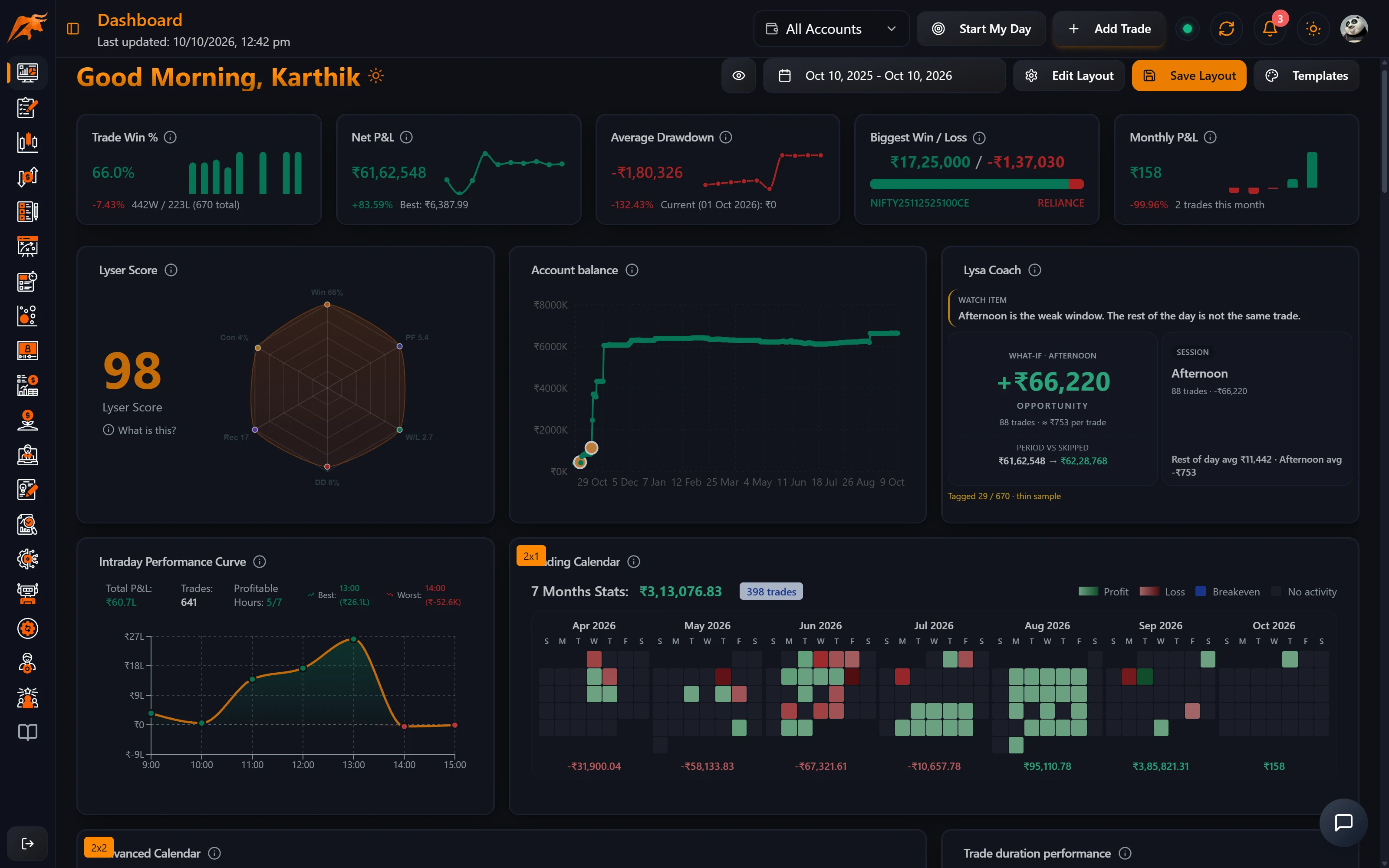
- Click Edit Layout. Empty slots appear with dashed borders.
- Click an empty slot to open the Widget Library. The top row holds small KPI widgets; the grid below holds larger charts.
- Search with Search widgets... or filter by category, then click a widget to add it.
- To remove a widget, hover over it and click the red ×.
- Use Add Row or Delete Row at the bottom to change the size of the grid.
- Click Save Layout.
Each widget can appear only once per layout, so widgets already on your dashboard are hidden from the library. For more detail, see Add widgets and Remove widgets.
Step 2: Arrange them by size
Widgets can't be dragged. To move one, remove it and add it again in a different slot. Each card in the Widget Library shows its size:
| Size badge | Space it takes |
|---|---|
| 1x1 | One block (all small KPI widgets, and standard large widgets) |
| 2x1 | Two blocks side by side |
| 1x2 | Two blocks stacked vertically |
| 2x2 | A square of four blocks |
A large widget is only added if there is enough free space to its right and below it. If nothing happens when you pick one, choose a slot further left or add a row first.
Step 3: Save layouts as templates
- Click Templates to open Dashboard Templates.
- Create a new template with a Template Name and an optional description. Tick Set as default template if you want it to open first.
- Switch between templates, delete ones you no longer need, or choose Make Default.
The dashboard always opens on your default template, and Save Layout updates whichever template you are viewing. A common setup is one "live session" template with Today's P&L and streaks, and one "weekly review" template with calendars, the Lyser Score and Lysa Coach. See Create a dashboard template.
Step 4: Set your display preferences
| Preference | How to change it | Where it is remembered |
|---|---|---|
| Hide amounts | Click the eye icon in the top bar. Rupee amounts show as ****. Chart axes are not masked. | This browser |
| Date range | The date button in the top bar. See Set the dashboard date range. | Until you reload |
| Account | The account selector in the header: All Accounts or one account. | This browser |
| Theme | The sun/moon icon in the header. See Theme toggle. | Your preference |
Step 5: Personalise the Shortcuts widget
The Shortcuts widget is the one widget with its own settings:
- Add Shortcuts to your layout from the Widget Library.
- Click the gear icon on the widget.
- Add links to external sites (for example your broker or a news site) or internal TradeLyser pages, and delete the ones you don't use.
- Save. Your shortcuts are stored with your account.
What you can't change
To save you searching, these options do not exist for dashboard widgets:
- Per-widget colours, fonts or themes. Colours follow the app theme, with green for profit and red for loss.
- A per-widget time period. Every widget uses the dashboard date range, except the Trading Calendar, Advanced Calendar and the Monthly P&L headline, which use fixed periods.
- A refresh rate. Use the header refresh icon after a sync. See Refresh dashboard data.
- Resizing a widget. Each widget has a fixed size.
Every widget has an (i) icon next to its title. Hover over it to see what the widget shows and how it is calculated.
Troubleshooting
| Problem | Fix |
|---|---|
| My changes disappeared | You left Edit Layout or reloaded without clicking Save Layout. Make the changes again and save. |
| A widget isn't in the library | It is already on this layout, or you are looking in the wrong library (small vs large slot). |
| A large widget won't add | There isn't enough free space to the right of or below the slot. Pick another slot or Add Row. |
| A different layout opens each time | The dashboard opens your default template. Use Make Default in Templates. |
All amounts show **** | The eye icon is on. Click it to show amounts. |
Frequently asked questions
Can I change the colours of a dashboard widget?
No. Widgets follow the light or dark theme, with green for profit and red for loss. You can switch the theme from the header.
How do I make a different dashboard layout my default?
Open Templates, find the layout and choose Make Default.
Can I add the same widget twice?
No. Each widget can appear once per template. Create a second template if you want a different arrangement.
Do widget preferences sync across devices?
Layouts and templates are saved to your account. The hide-amounts and account choices are remembered per browser.
Related guides
- Customise your dashboard
- Switch templates
- Navigate the sidebar
- Tags, widgets and dashboard metrics: how to use them